
How to Run a Polk County Warrant Search
Polk County does not publish a standalone active-warrant search page in its official sources. That surprises many people, but it reflects how warrants work. An active, unserved warrant can be sealed or held quiet so a person does not flee before it is served. Because of that, a true public list of every open warrant would defeat the purpose. The practical search uses two official channels and one direct contact.
First, check the Sheriff's jail portal. Once a warrant leads to an arrest, the booking record shows the charge and bail tied to it. Second, check Iowa Courts Online, where the case docket can show a warrant entry, a failure-to-appear, or a bench warrant on a live case. Third, when you need certainty, contact the court or the Sheriff directly. The steps below put that order to work.
- Search the Polk County jail portal for a recent booking and its charges.
- Look up the related case on Iowa Courts Online for warrant entries.
- Read the docket for terms like bench warrant or failure to appear.
- If unclear, call the Clerk of District Court about the case status.
- Confirm any open warrant with the Sheriff or an attorney before acting.
Where Polk County Warrants Appear
Warrant information surfaces in a few official spots rather than one search box. After an arrest on a warrant, the Sheriff's booking detail page shows the case number, the arrest agency, the bail amount, the bail type, and the charge text. A probation-violation warrant, for example, may list a charge with statute text such as section 908.11. On the court side, Iowa Courts Online can carry a docket entry that a warrant issued, especially a bench warrant for missing a hearing.
The image below comes from the Iowa Courts Online landing page, the free public docket where many warrant entries can be verified on the case record.
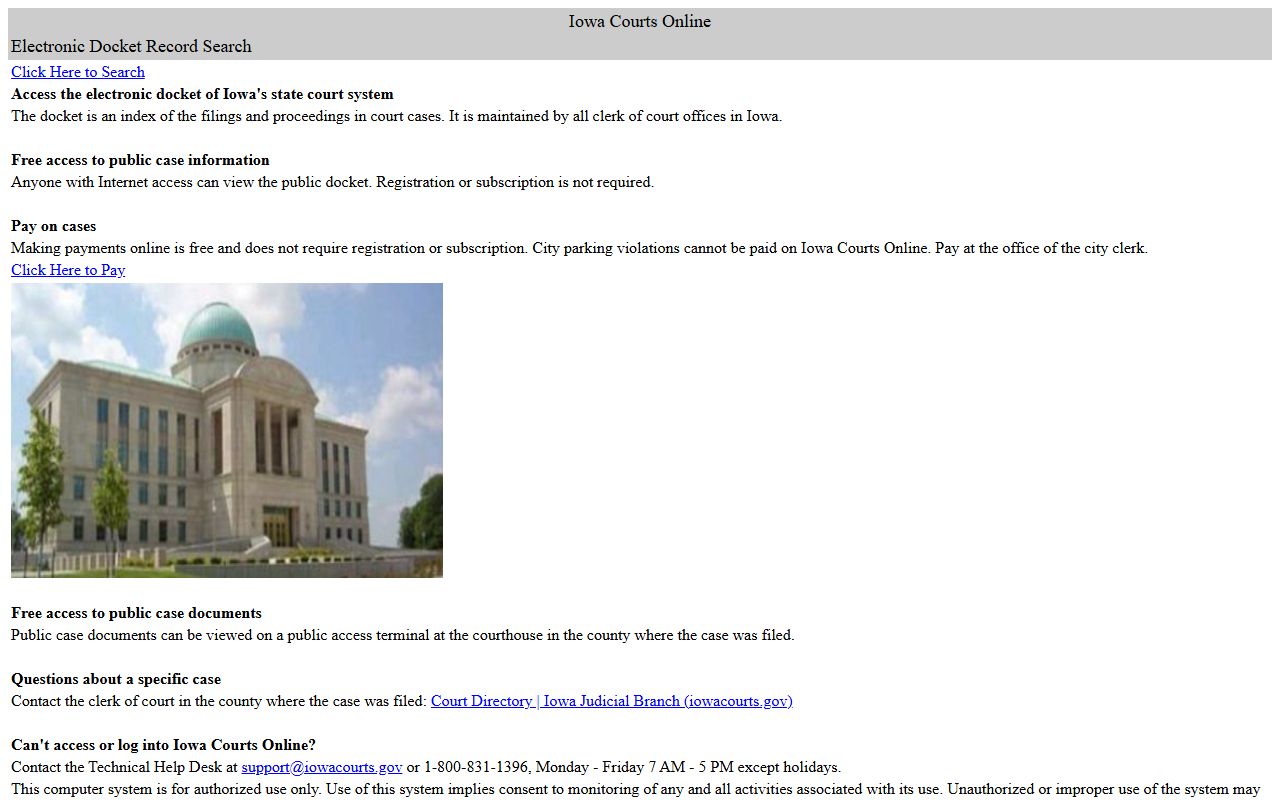
Reading the docket on the actual case is more reliable than any third-party warrant claim.
What a Polk County Warrant Record Shows
When a warrant ties to a booking, the public record exposes a clear set of fields. These come from the Sheriff's booking detail page and the linked case. The table below lists what you are most likely to see once a warrant has been acted on.
| Field | Type | Notes |
|---|---|---|
| Case Number | Text | Linked court case, such as FECR389008 |
| Arrest Agency | Code | Example PCSO for the Sheriff's Office |
| Bail Amount | Money | Set bail, which can be $0.00 |
| Bail Type | Text | Example NO BAIL |
| Charge Details | Text | Includes statute text, such as 908.11 |
| Booking / Case Date | Date/time | MM/DD/YYYY with time |
Before a warrant is served, these details may not be public at all. The fields appear once an arrest or booking connects the warrant to a case.
Types of Warrants in Polk County
Not all warrants are the same, and the type tells you how it came about. Arrest warrants start a criminal case when a judge finds probable cause. Bench warrants, sometimes called failure-to-appear warrants, issue when a person misses a required court date. Probation-violation warrants follow an alleged breach of supervision terms. Search warrants authorize a search rather than an arrest. Fugitive warrants involve another state, and no-bond warrants mean release on bail is not allowed.
Iowa Code chapter 804 governs arrests and warrants generally. The general process, including how an arrest warrant is issued and executed, is set out there. You can read it in Iowa Code chapter 804. The label on a docket entry usually tells you which kind of warrant a case involves.
Bail and No-Bond Warrants
Bail decides whether and how a person can be released after a warrant arrest. The booking record shows a bail amount and a bail type. A bail amount of zero paired with a NO BAIL type means the person cannot post bond and must wait for a court ruling. Higher-level charges and probation violations are more likely to carry no-bond terms.
Bail is set by the court, not by the jail. If bail is allowed, post it only through official jail or court channels, never through an unofficial middleman who promises to clear a warrant. The court controls the warrant, so the court and the jail are the only places that can confirm release terms.
Note: Never pay a third party who claims to remove a Polk County warrant; only the court and the Sheriff can confirm or resolve an open warrant.
How to Resolve an Outstanding Warrant
An open warrant does not go away on its own, and ignoring it usually makes things worse. The safest path is to verify the warrant through official sources, then act with legal help. The steps below follow the research-backed sequence for clearing a Polk County warrant.
- Verify the warrant through Iowa Courts Online, the issuing court, or law enforcement.
- Do not rely on third-party websites that claim to list warrants.
- Contact an attorney, especially for a criminal charge or probation violation.
- Ask the Clerk of District Court about the court date, status, and bond.
- If you plan to turn yourself in, call the Sheriff or jail for current intake steps.
- Post any bond only through official jail or court channels.
- After the matter resolves, recheck Iowa Courts Online, since clearance is not instant.
Sealed and Confidential Warrants
Some warrants are not public at all. Sealed warrants, juvenile warrants, and investigative warrants can stay confidential until they are served or a court unseals them. Grand jury and sealed search warrants are protected so an investigation is not tipped off. Juvenile matters fall under the confidentiality rules of Iowa Code chapter 232, and broader confidential-record categories sit in Iowa Code chapter 22, section 22.7.
This is why no honest source can promise a complete warrant list. A search can confirm warrants that have surfaced on a booking or a docket, but it cannot reveal a sealed or unserved warrant that the law keeps quiet.
Warrants and the Jail Booking Process
When a warrant leads to an arrest in Polk County, the person is taken to the county jail and booked. The booking steps include identification, a photograph, medical screening and classification, and entry into custody, with the record then linked to the court case and any bail. That is the moment warrant details become visible on the public roster, since the booking detail page ties the warrant charge to a case number and a bail figure.
Until that arrest happens, the warrant sits with the court and law enforcement. This is the core reason a warrant search depends on timing. A served warrant produces a booking record you can read; an unserved warrant may show nothing public at all. Court appearances, hearings, and case status that follow the booking should be confirmed on Iowa Courts Online, which tracks what happens next in the case.
Verifying a Polk County Warrant
Verification is the heart of any warrant search. The official systems carry disclaimers that data may be incomplete and that users should confirm details through the arresting agency or the court. A name match on a roster is not proof; people share names, and records can lag. The reliable check is the case record on Iowa Courts Online plus a direct call to the Clerk of District Court or the Sheriff.
If you are checking on your own status, an attorney can confirm a warrant quickly and advise on the safest next step. Acting on unverified information, or on a third-party site that claims to list warrants, can lead to wasted money or a missed chance to resolve the matter cleanly. Verify first, then act.
When to Involve an Attorney
A warrant tied to a criminal charge, a probation violation, a no-contact order, or a no-bond status is serious, and an attorney can protect your rights at the first appearance. Iowa provides appointed counsel for people who cannot afford a lawyer through the State Public Defender system, and that process runs through the court in the criminal case using financial affidavits. The basics of indigent defense are set out in Iowa Code chapter 815. Even a missed traffic date that became a bench warrant is easier to clear with guidance than alone.