
The District Court as Iowa's Trial Court
Iowa runs a unified state court system, and the District Court is its primary trial court. Polk County does not have its own county courts at law, justice-of-the-peace courts, or a separately elected probate court. Instead, the District Court handles civil, criminal, family, juvenile, probate, small claims, traffic, and magistrate matters as case types under one court. That keeps the structure simpler than in states with many local courts.
Because the court is part of the Judicial Branch, its case files are kept by the Clerk of District Court and appear on Iowa Courts Online. The image below comes from the official Iowa District Court page.
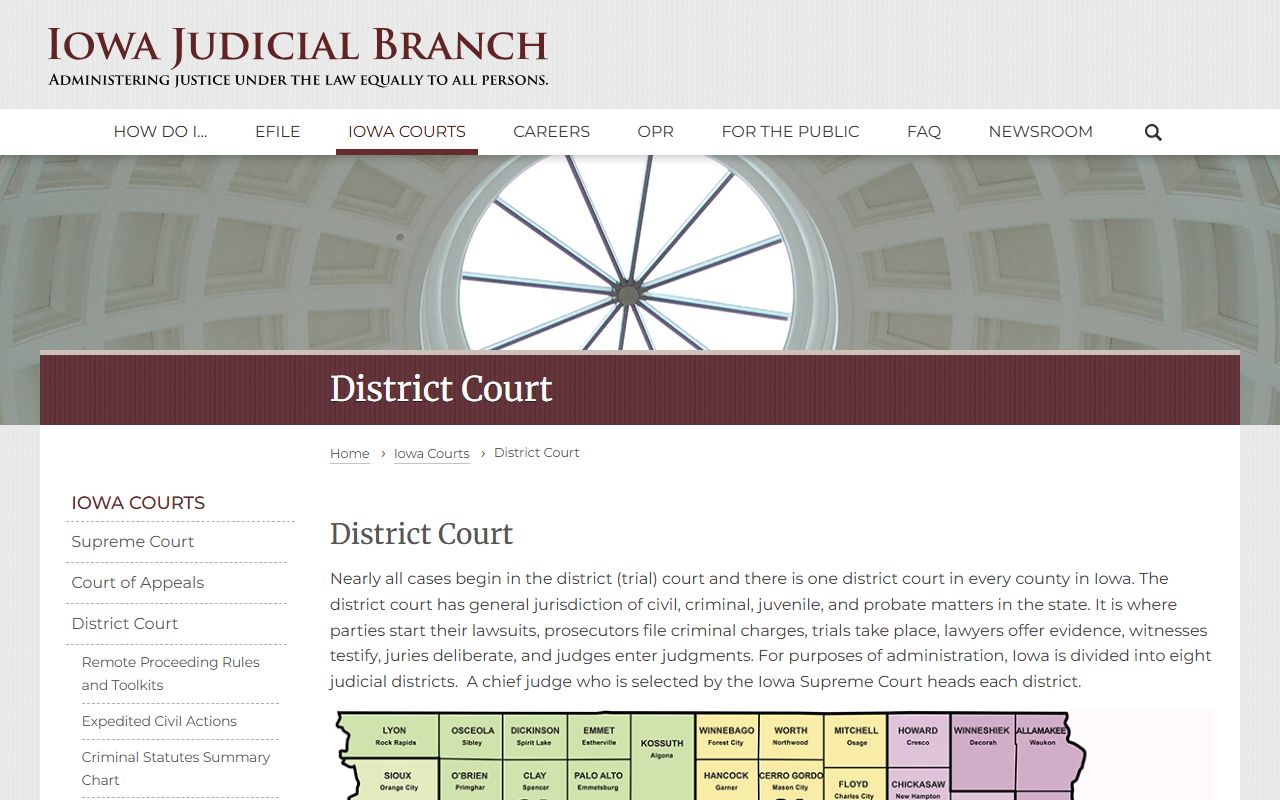
The District Court is where most Polk County cases begin and, for many, where they end.
Polk County in Judicial District 5
For administration, Iowa groups counties into judicial districts, and Polk County sits in Iowa Judicial District 5. The district structure handles assignment of judges and court administration, but it does not change the basic point: the trial court for Polk County is the District Court. A case filed in Polk County is a Polk County District Court case, searched and tracked through the statewide system.
Because Polk County is the state's most populous county and home to the capital, its District Court carries one of Iowa's heaviest caseloads, mixing routine matters with high-profile and government-related litigation.
How a Polk County Case Moves Through the System
A case starts at the trial level and can move up on appeal. The District Court hears the case first. From there, an appeal goes to the intermediate appellate court, and in some matters to the court of last resort. The flow below shows the path.
Case flow: Iowa District Court (Polk County) › Iowa Court of Appeals › Iowa Supreme Court
The Iowa Supreme Court is the court of last resort and supervises the whole Judicial Branch. The Iowa Court of Appeals is the intermediate appellate court that hears most transferred appeals. Whether a case lands at the Court of Appeals or the Supreme Court depends on the type of case and on transfer and retention decisions.
Jurisdiction and Case Types
The District Court's jurisdiction is broad. It hears civil suits of all sizes, criminal cases from simple misdemeanors to felonies, family matters like divorce and custody, probate, juvenile cases, small claims, and traffic. Each is a case type rather than a separate court. Driver-history records are the exception; those are kept by the Iowa Department of Transportation, not the court.
The table below lists the main offices tied to the Polk County District Court and where they sit. Confirm direct phone lines through the Iowa Court Directory before calling.
| Court / Office | Address | Notes |
|---|---|---|
| Polk County District Court / Justice Center | 222 Fifth Avenue, Des Moines, IA 50309 | Primary trial court location |
| Clerk of District Court | Des Moines courthouse campus | Maintains dockets and case files |
| Polk County Attorney, Criminal Division | 222 Fifth Avenue, Des Moines, IA 50309 | Prosecutor; phone 515-286-3737 |
| Polk County Recorder | 111 Court Avenue, Suite 250, Des Moines | Vital and real estate records |
District Court Versus the Appellate Courts
It helps to see how the trial court differs from the courts above it. The comparison below contrasts the District Court with the two appellate courts in Iowa.
| Point | District Court | Court of Appeals | Supreme Court |
|---|---|---|---|
| Role | Trial court | Intermediate appeals | Court of last resort |
| Hears evidence? | Yes | No, reviews the record | No, reviews the record |
| Scope | Polk County | Statewide | Statewide |
| Typical work | Trials and hearings | Most transferred appeals | Branch supervision, key appeals |
Most people deal only with the District Court, since trials, hearings, and case files all live there.
Civil, Family, Criminal, and Probate Work
Within the one court, the work divides by subject. Civil cases handle disputes over money, contracts, and property. Family cases cover divorce, custody, support, and paternity. Criminal cases run the range of misdemeanors and felonies. Probate handles estates, wills, guardianships, and conservatorships under Iowa Code chapter 633. Each subject has its own filings and its own privacy rules, but all are District Court cases.
For records, that means one search tool reaches all of them. The court records page covers the online docket, and the probate records page covers estates and guardianships in more depth.
Magistrate and Small Claims Matters
Lower-level matters are handled as functions of the District Court rather than by a separate court. Magistrates take on simple misdemeanors, initial appearances, small claims, and other assigned matters. Small claims offer a simpler path for lower-dollar civil disputes, landlord-tenant issues, and collections. These cases still appear in the same online docket as larger District Court matters.
So a tenant deposit dispute and a felony case both run through the District Court, just at different levels and with different procedures. The case-type prefix on the docket tells you which kind you are looking at.
Specialty Courts and Programs
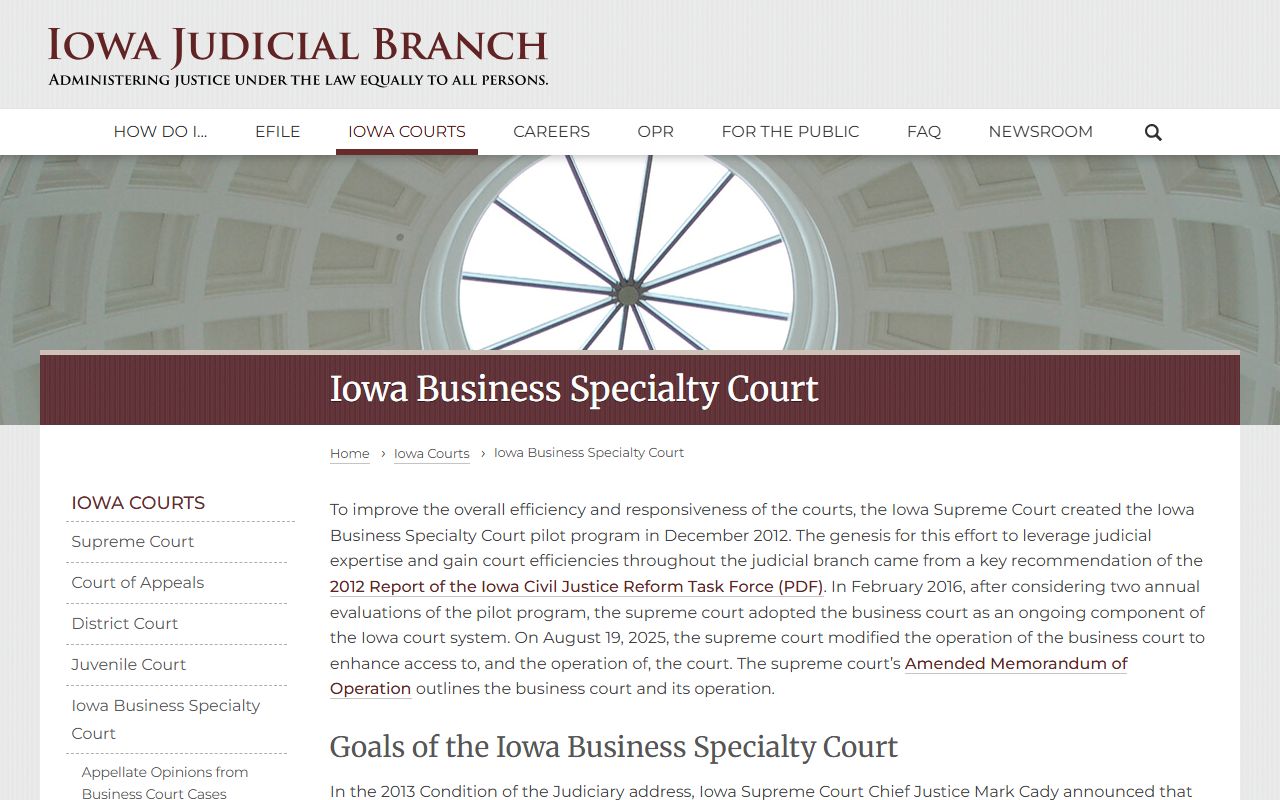
Iowa runs a statewide Business Specialty Court for complex commercial disputes. It is not a Polk-only court, but a qualifying business case filed in Polk County can be assigned to it through the Judicial Branch. It does not replace the District Court; it is a specialized handling track for cases that meet the criteria.
The image below comes from the Iowa Business Specialty Court overview.
At the county level, the Polk County Attorney also runs a Restorative Justice Center, which can shape how some criminal cases resolve.
Courthouse Location and Access
The District Court works from the downtown Des Moines court campus, anchored by the Polk County Justice Center on Fifth Avenue. Court, prosecutor, recorder, and sheriff services are spread among downtown and northeast Des Moines buildings, so confirm your courtroom before you travel. Expect security screening at the entrance, with no weapons and limits on recording in courtrooms.
Polk County Justice Center
222 Fifth Avenue
Des Moines, IA 50309
515-286-3737
Mon-Fri 8:00 a.m.-4:30 p.m.
Why People Search for a County Court
Many searches use phrases like "Polk County Court" or "Polk County district clerk," carried over from how other states name their courts. Iowa's unified system routes all of those to the District Court and the Clerk of District Court. There is no separate county court at law, no justice court, and no standalone probate court to track down. That can be a relief once you know it, because it means one court and one online docket cover almost everything.
So if you arrived looking for a county-level court, the District Court is the answer. The same is true for probate, traffic, and small claims, which are all case types of this court rather than separate venues. Knowing this up front saves time that would otherwise go to hunting for offices that do not exist in Iowa.
Cases That Go to Federal Court Instead
Not every case for people in Polk County belongs in the District Court. Federal crimes, federal-question civil suits, and many civil-rights cases are filed in the U.S. District Court for the Southern District of Iowa, with appeals to the Eighth Circuit and bankruptcy in its own federal court. Those files are not in Iowa Courts Online; they are reached through PACER. The District Court handles state matters, while federal matters follow a separate track entirely.
Self-Help for Polk County Court Users
People without a lawyer can use the Iowa Judicial Branch self-help resources, which cover divorce, custody, support, small claims, name changes, and protecting personal information. Most case types use the state eFile system, and fee waivers for those who cannot pay are handled through court forms. Court staff cannot give legal advice, but they can point you to the right form and explain a filing fee. For broader help, Iowa Legal Aid and the State Public Defender serve those who qualify.