
How to Find Polk County Arrest Records
Recent arrests in Polk County show up first on the Sheriff's jail portal. The Polk County jail and arrest information site lists current inmates, bookings from the last 24 hours, and bookings from a prior date. Each entry links to a booking detail page with the charges and bail. The portal notes that people held on federal charges are not listed and that the data should be verified.
For the case that follows an arrest, use Iowa Courts Online to read the criminal docket. The arrest data tells you a person was booked; the court docket tells you what the State charged and how the case is moving. The steps below cover both.
- Open the Polk County jail portal and check current or recent bookings.
- Click a name to open the booking detail with charges and bail.
- Note the case number listed on the booking, such as FECR389008.
- Search that case number on Iowa Courts Online for the criminal docket.
- Verify any detail with the arresting agency before relying on it.
What a Polk County Arrest Record Shows
The public booking detail page carries a clear set of fields. A sample Polk County profile showed a mugshot, name, inmate number, age, hair and eye color, race, sex, height, weight, holding location, booking number, booking date, arrest agency, bail amount, bail type, and a charges table. The arrest agency appears as a code, such as PCSO for the Polk County Sheriff's Office. Charges list a count, a class or code, and the statute text.
| Field | What It Shows |
|---|---|
| Name and Inmate Number | The person booked and their jail ID |
| Booking Date | When the person was booked into custody |
| Arrest Agency | The agency code, such as PCSO |
| Bail Amount / Type | The set bail and its terms, such as NO BAIL |
| Charges | Count, class or code, and statute text |
| Case Number | The linked court case, such as FECR389008 |
The portal carries a disclaimer that the Sheriff's Office does not warrant the data is accurate and that users should verify through the arresting agency or Iowa Courts Online.
Arrest Record Versus Criminal Court Record
People often mix up an arrest record and a criminal court record, but they come from different offices and mean different things. The comparison below sorts them out.
| Point | Arrest Record | Criminal Court Record |
|---|---|---|
| Source | Sheriff's Office jail portal | Clerk of District Court, via Iowa Courts Online |
| What it shows | Booking, charges at arrest, bail | Charges, pleas, hearings, disposition |
| Stage | The start of a case | The full case through judgment |
| Means guilt? | No | Only if there is a conviction |
For the full case history behind an arrest, the better source is the Polk County court records docket, not the booking page alone.
Charges Versus Convictions
This distinction matters more than any other on an arrest record. A charge is what law enforcement or the prosecutor accuses a person of. A conviction is a finding or admission of guilt entered by the court. A person can be arrested and charged, then have the case dismissed, reduced, or end in an acquittal. The arrest stays in the booking history even when no conviction follows.
Because of that gap, an arrest record alone is a poor measure of guilt. Always check the court docket for the disposition. The image below comes from the U.S. Attorney's Office for the Southern District of Iowa, the federal prosecutor for this region.
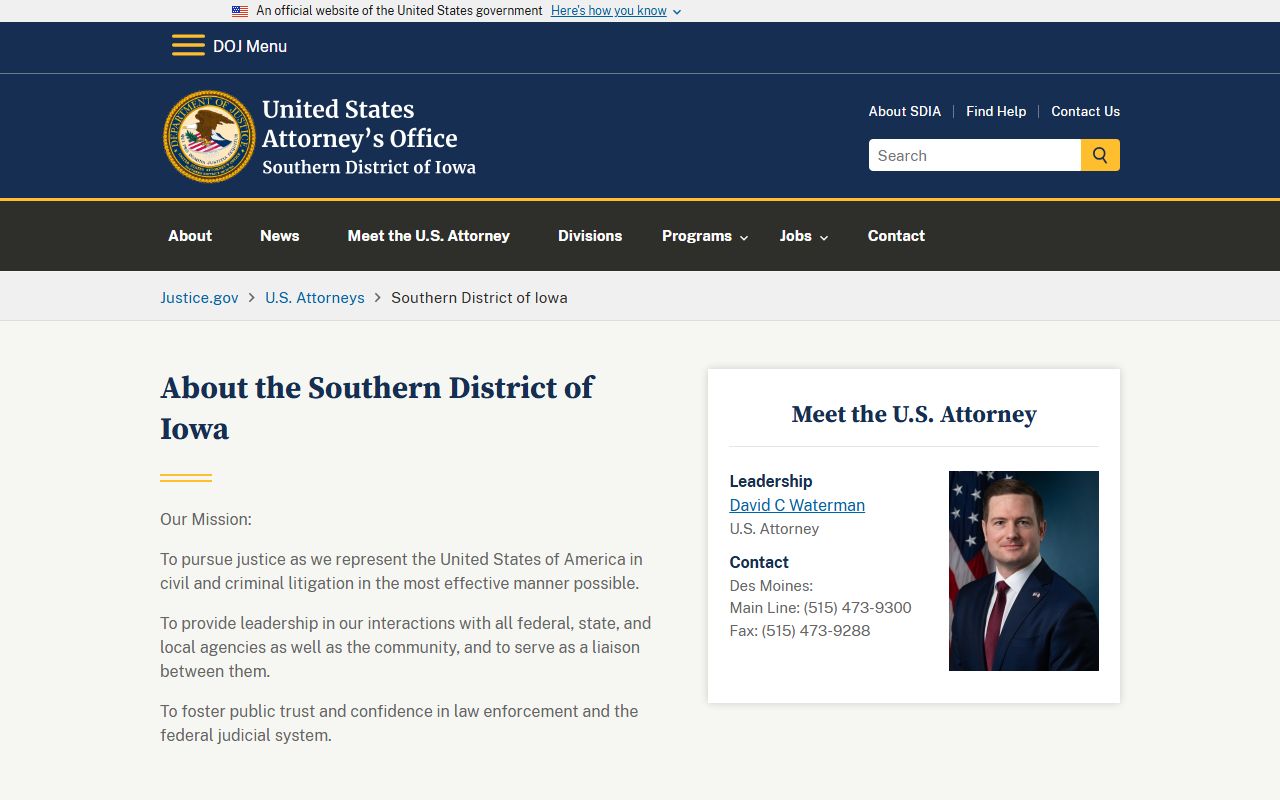
Federal charges are prosecuted separately from state charges and do not appear on the county jail roster.
The Polk County Attorney's Role
Iowa uses the title County Attorney rather than District Attorney. The Polk County Attorney, Kimberly Graham, leads the office that prosecutes criminal cases for the county. The Criminal Division works from the Polk County Justice Center at 222 Fifth Avenue in Des Moines. The office decides what charges to bring after an arrest, so the charges on a booking page can change once the prosecutor reviews the case.
The office is the prosecutor, not the records clerk. For copies of a criminal case file, you still go to the Clerk of District Court or Iowa Courts Online. You can reach the Criminal Division by phone at 515-286-3737, Monday through Friday. The office also runs a Civil Division and a Juvenile Division, and its programs include case review, a license reinstatement program, and payment plans. Those programs can shape how a case ends, which is one reason the charges on a booking page are not the final word.
Polk County Attorney, Criminal Division
Polk County Justice Center
222 Fifth Avenue
Des Moines, IA 50309
515-286-3737
Criminal History and Access Law
Iowa controls how criminal history data is shared. Iowa Code chapter 692 governs criminal history and intelligence data and limits some dissemination. The broader open-records law, Iowa Code chapter 22, gives the public a right to many records but lists confidential categories under section 22.7. Arrest and warrant process itself is set out in Iowa Code chapter 804.
Because of these limits, a public jail booking is not a full criminal history. A formal background check uses different state channels and is governed by chapter 692.
Note: A jail roster shows current and recent custody, not a complete criminal history, and it should not be used for an FCRA-regulated background check.
Sealed Versus Expunged Records
Some arrest and criminal records can be removed from public view, but the rules are narrow. Sealing restricts access by court order or statute. Expungement removes an eligible record from ordinary public access. The two are related but not identical, and neither is automatic.
| Point | Sealed | Expunged |
|---|---|---|
| Effect | Public access is restricted | Record removed from public access |
| Authority | Court order or statute | Iowa Code chapter 901C and related law |
| Who may still see it | Courts and authorized agencies | Courts and authorized agencies |
Expungement under Iowa Code chapter 901C depends on the offense, the result, waiting periods, and paid obligations. Common denial reasons include an ineligible offense, an incomplete waiting period, or unpaid costs. Review the statute and court forms rather than assume eligibility.
Recent Arrests and Booking Lists
The Polk County jail portal is built around timing, which makes it a strong tool for finding recent arrests. It publishes a current inmate listing, a list of bookings from the previous 24 hours, and a list of bookings from a prior date. Each list is a table with a name, an age, a book date, and a detail link. If you are looking for someone arrested last night, the previous 24 hours list is the fastest place to check, and the prior-date list covers the day before.
Two limits are worth remembering. First, the portal states that people held on federal charges are not listed, so a federal arrest will not appear there. Second, the roster is a point-in-time view. A person booked and released quickly may move off the current list before you look, which is exactly why the release tools and the 365-day released search exist. For people no longer in custody, the released inmates page covers that search in detail.
Mugshots in Polk County Arrest Records
A booking photo, often called a mugshot, appears on the public detail page for many people in custody. On the Polk County portal, the photo loads from a booking-number image path tied to the same record. The mugshot is part of the public booking record, alongside the physical description fields like height, weight, and hair and eye color. It identifies the person booked at that moment.
A mugshot does not prove guilt. It only shows that a person was booked. Charges can be dropped, reduced, or end in acquittal, and the booking image stays attached to that arrest event regardless of outcome. Treat a mugshot the same way you treat the rest of an arrest record: as a starting point that the court docket then completes. Private mugshot websites are not official sources; the Sheriff's portal and Iowa Courts Online are the reliable places to confirm a booking.
Restorative Justice in Polk County
The Polk County Attorney runs a Restorative Justice Center. The office describes restorative justice as a way to view crime as harm to victims and the community rather than only a rule violation. It stresses offender accountability, victim and community participation, repairing harm, and reintegration. For people with an arrest record, programs like this can be part of how a case resolves, so they belong in the picture alongside the docket.