
What a Polk County Court Docket Is
The docket is a chronological index of a case. Each line, called a docket entry, marks something that happened: a complaint, an answer, a motion, an order, a hearing, a plea, a judgment, or a payment. Iowa Courts Online describes its docket as an index of filings and proceedings maintained by every clerk of court office in the state. That means a Polk County case and a case from another county sit in the same system.
The docket is not the same as the full case file. It points to documents and records events, but many of those documents are only viewable at the courthouse. Reading the docket gives you the shape of a case without every page.
Dockets are useful because they are current and free. A landlord checking a tenant eviction history, a reporter following a criminal case, or a party tracking their own matter can all read the same public docket without paying a fee or proving a reason. The entries are dated, so you can see the order events happened in and how long each step took. That timeline is often the most valuable thing a docket offers, since it shows whether a case is moving, stalled, closed, or on appeal. Keep in mind that a single docket line rarely tells the whole story; read the surrounding entries before drawing a conclusion.
How to Search Polk County Court Dockets
Docket access is free on Iowa Courts Online, and no account is needed. You can search by case number or party name, then open a case to read its entries. The screenshot below comes from the Iowa Courts Online search frame, the page reached from the Judicial Branch search link.
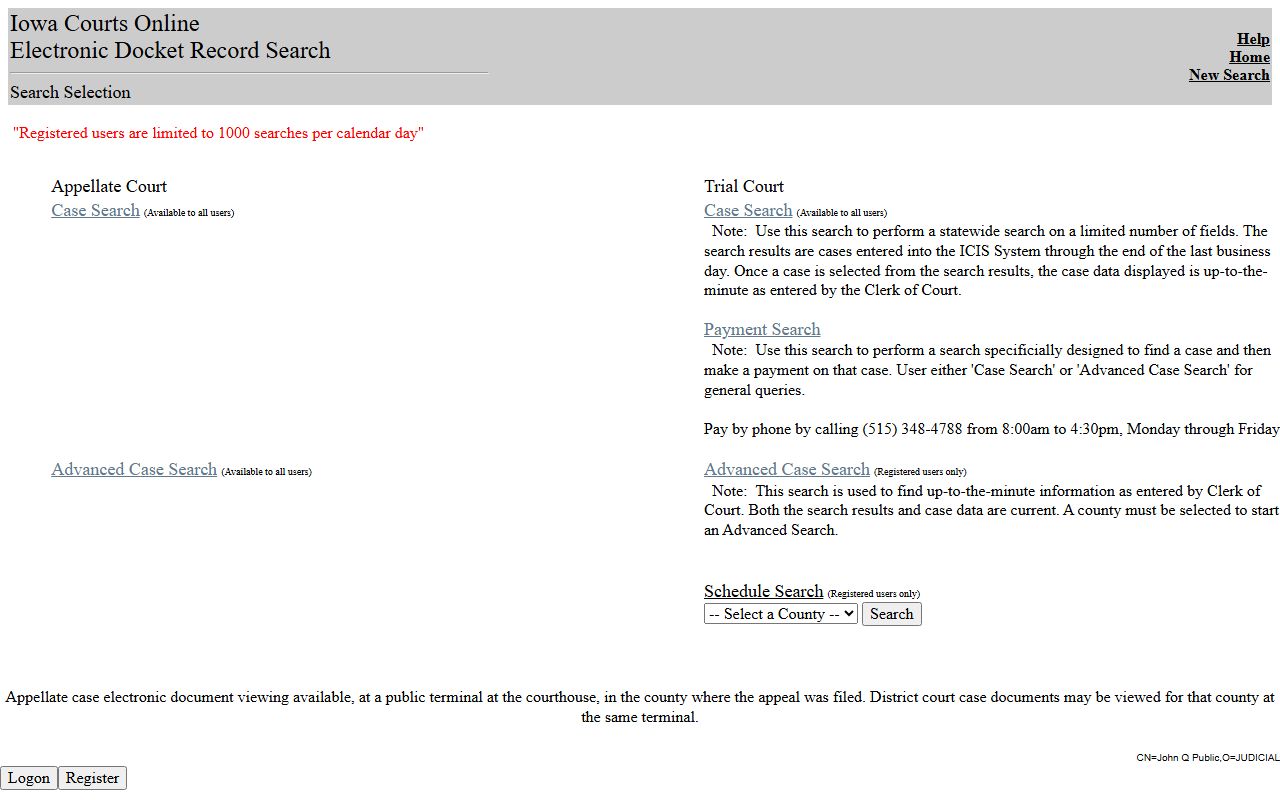
The steps below walk through a basic Polk County court dockets lookup.
- Open Iowa Courts Online and click "Click Here to Search."
- Enter a case number, or use a party name if you do not have one.
- Select Polk County where the county filter is shown.
- Open the matching case to view its docket entries in date order.
- Note the next hearing date and the most recent filing.
What Polk County Court Dockets Show
Docket entries follow a case from start to finish. Early entries open the case and bring in the parties. Middle entries track motions, hearings, and orders. Closing entries record the judgment, sentence, or dismissal. The sample below shows the kinds of docket entries you will see in a Polk County District Court case.
| Docket Entry | What It Means |
|---|---|
| Petition or Complaint | The filing that opens a civil case |
| Trial Information | The Iowa felony charging document from the prosecutor |
| Appearance / Answer | A party or attorney joins or responds |
| Order or Ruling | A written direction from the judge |
| Hearing Set | A scheduled court date and time |
| Judgment / Sentence | The outcome entered by the court |
Some entries are short codes. When an entry is unclear, the Clerk of District Court can explain what it records.
Hearing Dates and Case Status
Many people open a docket to find a hearing date. The docket shows the hearing type, date, and time, and often the courtroom or judicial officer where that detail is public. Status fields tell you whether a case is pending, disposed, dismissed, or has an active warrant. For criminal cases, the docket also tracks bond, pleas, and sentencing.
Dates can change. A continuance moves a hearing, and the new date shows up as a fresh entry. Always read the most recent entries, since an older date may already be reset.
Note: If a hearing date matters for your own case, confirm it with the Clerk of District Court, because online entries can lag behind a last-minute change.
Paying Fines and Costs on a Docket
Iowa Courts Online also handles payments. The landing page says making a payment on a case is free to use and does not require registration. You can pay fines, court costs, and other case charges online. One clear exception applies: city parking violations cannot be paid through Iowa Courts Online and must be paid at the office of the city clerk.
The image below is from the Iowa Judicial Branch pay-a-fine page, which explains the official online payment options.
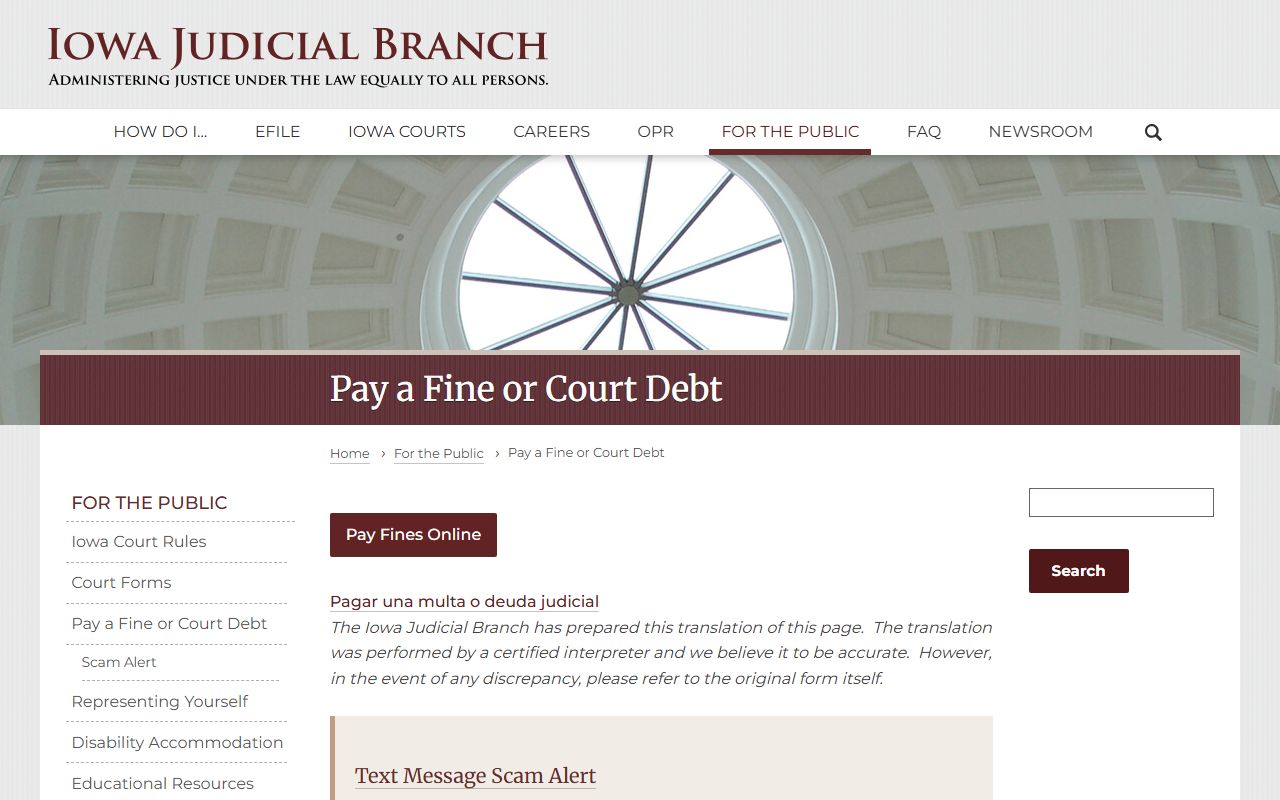
Paying through the official site keeps the payment tied to the right case on the docket.
Dockets Versus Full Case Files
It is worth repeating the difference, since it trips up many searchers. The docket is the index of events; the case file is the stack of actual documents. Iowa Courts Online gives free access to the public docket. Full documents are often available only on a public access terminal at the courthouse in the county where the case was filed.
So a Polk County court dockets search can confirm that a motion was filed and ruled on, but reading the motion itself may mean a trip to the courthouse or a copy request to the clerk. Both serve different needs, and knowing which one you want saves a wasted step.
Which Courts Publish Polk County Dockets
Iowa runs a unified court system, so almost every trial docket for the county comes from one place: the Iowa District Court. Polk County sits in Iowa Judicial District 5. The District Court handles civil, criminal, family, juvenile, probate, small claims, and traffic matters as case types, not as separate courts, so their dockets all appear in the same online system. Magistrate and small claims work is a function of the District Court rather than a different court with its own docket.
Appeals create their own dockets at the Iowa Court of Appeals and the Iowa Supreme Court. Those appellate dockets are tracked through the Judicial Branch, and a District Court case that is appealed will note that step in its entries. Federal cases for this area do not appear in Iowa Courts Online at all; they are docketed in the U.S. District Court for the Southern District of Iowa and reached through PACER. Juvenile dockets stay confidential under state law, so they will not show in a public search even though they run through the same District Court.
Civil Dockets Versus Criminal Dockets
A civil docket and a criminal docket track different events, even though both live on Iowa Courts Online. The comparison below shows how the two differ in who files, what the entries cover, and how a case ends.
| Feature | Civil Docket | Criminal Docket |
|---|---|---|
| Who starts it | A plaintiff or petitioner | The State, through the County Attorney |
| Opening filing | Petition or complaint | Complaint or trial information |
| Key middle entries | Motions, discovery, hearings | Arraignment, plea, bond, pretrial |
| How it ends | Judgment, settlement, dismissal | Sentence, acquittal, dismissal |
| Money fields | Damages, garnishment, liens | Fines, costs, restitution, bond |
Reading the right kind of docket the right way keeps you from misjudging a case. A civil judgment is a debt finding, not a crime, and a criminal disposition is not the same as a civil award. The labels matter.
Public Access Terminals at the Courthouse
When the docket points to a document you cannot open from home, the next step is a public access terminal. Iowa Courts Online states that public case documents can be viewed on a terminal at the courthouse in the county where the case was filed. For a Polk County case, that means the courthouse in Des Moines. Staff cannot give legal advice, but the Clerk of District Court can help you find the case and use the terminal.
Bring the case number to save time. If you need a certified copy for a legal use, ask the clerk, since a screen view is not a certified document. Certified copies carry the court seal and are the version courts and agencies accept.
Polk County Case Number Formats
Iowa case numbers carry a case-type prefix and a number. A public Polk County cross-reference showed a felony case styled FECR389008. Other prefixes mark civil, small claims, probate, domestic, juvenile, and traffic matters. If you have the case number, the docket search is fast and exact. If you only have a name, expect more results to sort through, especially with common names in a county this size. When two people share a name, use the filing date or the case type to tell the records apart.