
Iowa's Open Records Law
Iowa's public records framework is Iowa Code chapter 22. It gives every person the right to examine and copy public records and to publish or share them unless a law says otherwise. Section 22.2 sets that right, section 22.3 allows reasonable fees tied to actual cost, and section 22.7 lists the confidential categories that can be withheld. This is a state framework, not the federal FOIA, so requests to county and state offices use chapter 22.
You can read the law in Iowa Code chapter 22. County offices also operate under Iowa Code chapter 331, which covers county home rule and recordkeeping. The right to records does not require you to give a reason or prove who you are for most ordinary records, though certain sensitive records carry their own access rules.
Polk County Records Beyond the Courts
The court system is only one source of public records. The Polk County Recorder keeps real estate records, vital records such as births, deaths, and marriages, military records, and more. The Sheriff's Office holds incident reports, accident reports, and related law-enforcement records. The Clerk of District Court holds court case files. Each office is the right destination for its own records, and sending a request to the wrong one slows everything down.
So a deed request goes to the Recorder, a crash report goes to the Sheriff, and a court file goes to the clerk or Iowa Courts Online. Matching the record to the office is the first practical step in any public records search.
How to File a Public Records Request
Filing a request is straightforward once you know the office. The Sheriff's Office, for example, offers an online Public Records Request Center along with mail, phone, and in-person options. The steps below outline a typical Polk County public records request.
- Identify which office holds the record you need.
- Describe the record clearly, with dates, names, or a case or report number.
- Submit through the office's online center, by mail, by phone, or in person.
- Provide a contact phone or email so staff can quote the total fee.
- Pay the invoiced fee, since records are released after payment.
The Sheriff's records request page notes that payment is not collected until fees are calculated and an invoice is provided, and the record is not released until payment is received.
Sheriff's Records Request Fields
The Sheriff's records request collects how you want to be reached and how you will pay, since fees vary by record. The table below lists the request elements drawn from the official records request page.
| Field / Requirement | Type | Required | Notes |
|---|---|---|---|
| Online request center | Web portal | If requesting online | Online payments accepted |
| Mail request | Optional | Attention: Jerry Noble, 5995 NE 14th Street | |
| Phone request | Phone | Optional | Records line 515-286-3313 |
| Contact phone / email | Contact | Required | So staff can quote total fees |
| Payment | Instruction | Required | Cash, money order, business checks |
Records taking more than an hour, or running over ten pages, can carry added charges, so the contact step matters.
Polk County Public Records Fees
Fees follow the actual-cost principle of Iowa Code chapter 22, and the Sheriff publishes a clear schedule for its records. Court and recorder fees are set by their own schedules. The table below shows the Sheriff's published amounts.
| Item | Amount |
|---|---|
| Police incident report | $5.00 |
| Vehicle accident report | $5.00 |
| Dispatch log | $5.00 |
| Animal control report | $5.00 |
| In-car video, photos, or 911 audio | $35.00 |
| Requests over one hour | $35.00 per hour added |
Records over ten pages may add $0.25 per extra page. The full policy is on the Sheriff's records request page.
Court Records Versus County Records
It helps to separate two big buckets. Court records are case files, dockets, and orders from the District Court, searched on Iowa Courts Online and obtained from the Clerk of District Court. County records are everything else the county keeps, from deeds to crash reports, obtained from the Recorder, the Sheriff, or another department. They live under overlapping but different rules.
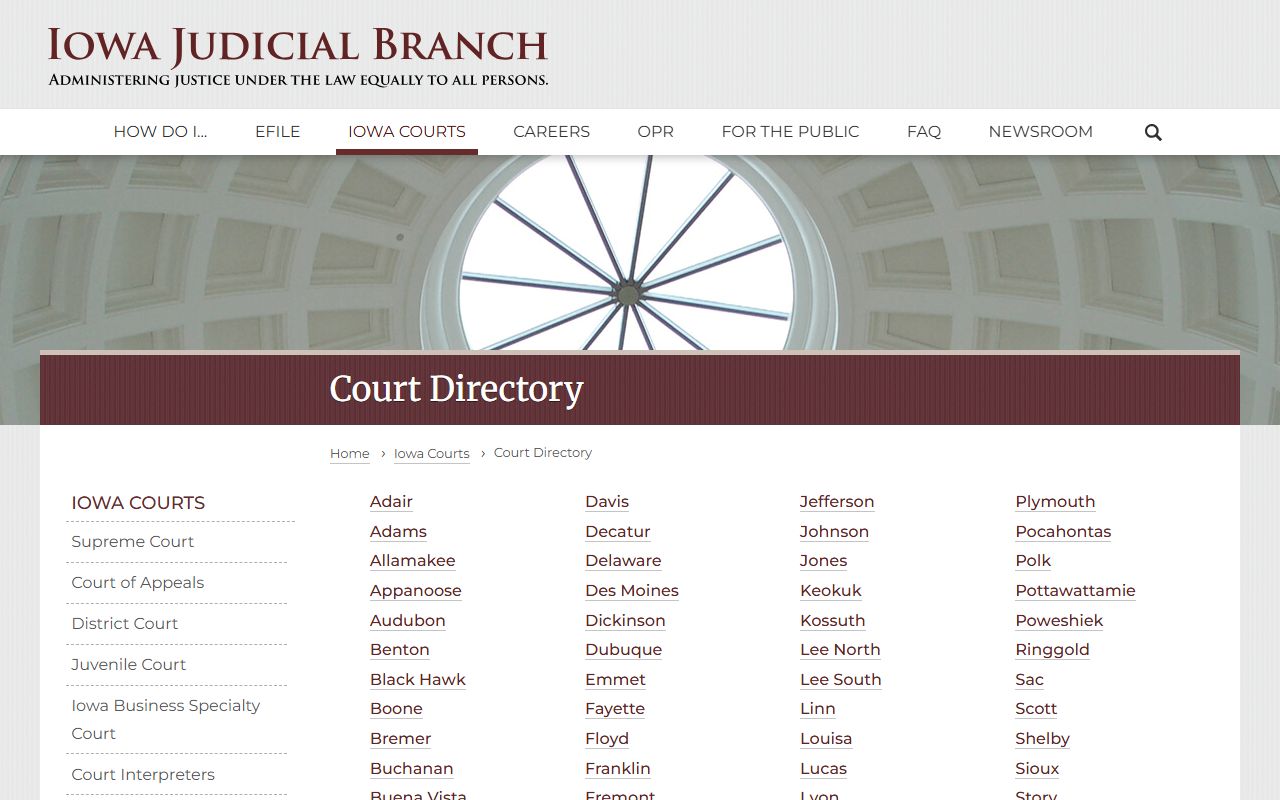
The image below is from the Iowa Court Directory, which helps locate the clerk and court offices that hold court records.
For court files specifically, the court records page covers the online search in detail.
Real Estate and Recorded Documents
Some of the most-requested county records are real estate documents. The Polk County Recorder preserves deeds, mortgages, and other recorded instruments tied to property in the county. Title companies, lenders, attorneys, and homeowners all pull these records to confirm ownership and liens. The Recorder describes its mission as keeping a true, reliable, and permanent account of real property and other official records.
Recorded documents are generally public, though personal identifiers are protected. If you are researching a property, the Recorder's search and request options are the place to start, and the office has a dedicated real estate phone line separate from vital records.
Vital Records Through the Recorder
Birth, death, and marriage records are vital records, kept by the Recorder's Vital Records Department rather than the courts. Access to certified vital records can be limited to eligible people, so the Recorder may ask for identification or proof of relationship. Same-day vital-record service ends before the office closes, which matters if you plan to walk in for a certified copy.
For marriage records specifically, the marriage and divorce records page covers the process in more depth, including the license application and certified copies.
If a Request Is Denied or Delayed
Most requests are filled, but sometimes an office withholds a record or part of it. When that happens, the office should cite the legal basis, often a category in Iowa Code section 22.7. If you believe a record was wrongly withheld, you can ask the office to reconsider, point to the specific record you want, and request the legal reason in writing. Iowa Code chapter 22 also contains enforcement procedures for disputes.
Many delays are simply about scope. A request that names exact dates, parties, or report numbers is easier to fill than a sweeping one. Narrowing the ask, then following up politely, resolves most slow responses without a formal dispute.
Confidential Records and Exceptions
The open-records right is broad but not total. Section 22.7 lists categories that can be withheld, including medical records, certain law-enforcement investigative reports, trade secrets, and other protected material. Juvenile records are confidential under Iowa Code chapter 232, and personal identifiers like Social Security and account numbers are redacted. So a request can be granted in part, with sensitive pieces removed.
If an office withholds a record, it should point to the legal basis. Understanding section 22.7 helps you tell a lawful withholding from one worth questioning.
Note: An office may release a record with parts redacted under Iowa Code section 22.7, so a partial response is not always a denial.
Response Times and Costs
Iowa law expects records to be produced promptly and without unreasonable delay, and offices can charge reasonable fees for copying and retrieval. A simple report may be ready quickly, while a large or complex request takes longer and costs more. Because the Sheriff calculates the fee before release, you will know the cost before you commit. For court copies, the clerk applies the Judicial Branch schedule.
If a request is large, narrowing it by date or topic can cut both the wait and the fee. A clear, specific request is almost always faster than a broad one. It also helps to ask for an electronic copy when one exists, since digital delivery can be quicker and cheaper than paper.