
How to Look Up Polk County Jail Population Data
There is no single dashboard that reports every Polk County population figure. Instead, the data sits across a few official sources. The Sheriff's jail portal gives a current roster you can count on a given day. State and national agencies, including the Bureau of Justice Statistics, the Vera Institute, and the Prison Policy Initiative, publish broader and historical numbers. To build an accurate picture, you read the live roster for today and the agency reports for trends and rates.
This page is population data, not an individual lookup. To find a specific person in custody, the name search lives on the inmate records page. The figures here describe the jail as a whole: how big it is, how it is counted, and how it compares.
Polk County Jail Capacity Overview
The clearest county-specific number is capacity. The Sheriff's detention page states the Polk County Jail holds 1,500 beds and can expand by another 1,000. The facility opened on November 1, 2008, covers 325,000 square feet, and sits on 40 acres just north of Des Moines. It is a direct-supervision facility. The table below captures the published capacity figures.
| Facility | Address | Capacity | Notes |
|---|---|---|---|
| Polk County Jail | 5995 NE 14th Street, Des Moines, IA 50313 | 1,500 beds | Direct supervision; opened 2008; expandable by 1,000 |
This bed count is the only official capacity figure located in the county's own pages. It describes how much the jail can hold, not how many people are inside on a given day.
Daily Roster Versus Average Daily Population
Two numbers get confused all the time: the daily count and the average daily population. The Sheriff's portal shows a current roster, which is a snapshot of who is in custody at the moment you look. You can count it, but it changes hour to hour as people are booked and released. Average daily population, by contrast, is a figure agencies calculate over a period, smoothing out the daily swings.
For Polk County, the live roster is the reliable point-in-time source, but it is not an official average. A single day can run high or low for many reasons, so one count should never be treated as the jail's typical population. When you need an average or a trend, the agency reports below are the right place to look.
Note: A single daily roster count is a snapshot, not an average, so do not treat one day's number as the jail's normal population.
Where the Population Data Comes From
Reliable jail population numbers come from a small set of official and research sources, and each answers a different question. The county portal gives today's roster. The Bureau of Justice Statistics publishes national jail population reports. The Vera Institute tracks county-level jail trends for many counties. The Prison Policy Initiative provides Iowa statewide context. The table below shows which source to use for which figure.
| Data Point | Best Source | Scope |
|---|---|---|
| Today's count | Polk County jail portal | County, point-in-time |
| Average daily population | County budget or Vera data | County, over time |
| National jail rate | Bureau of Justice Statistics | National |
| Statewide context | Prison Policy Initiative Iowa | State |
The image below is from the Bureau of Justice Statistics, the federal source for national jail population reports.
Pulling from the right source keeps a county figure from being mistaken for a state or national one.
Facility Design and Expansion Capacity
The jail's design tells you how the county planned for growth. A 1,500-bed direct-supervision facility on 40 acres, with room to add 1,000 beds, was built to handle a large and growing metro population through at least 2030. Direct supervision means staff are stationed inside housing units rather than only watching from a control booth, a model meant to improve safety and management.
That expansion capacity matters for population planning. A jail near its limit has fewer options, while one with room to grow can absorb swings without emergency measures. The published figures show Polk County built in that headroom from the start. Because Polk County is the state's most populous county and home to Des Moines, the jail also handles the booking volume of a busy metro, which is part of why the facility was sized the way it was.
Pretrial Versus Sentenced Population
Jail populations split into two broad groups. Pretrial detainees are held while their cases are pending and have not been convicted. Sentenced inmates are serving a term, usually a shorter county sentence. The mix matters, because a jail heavy with pretrial holds reflects bail and case-processing patterns more than sentencing.
Official Polk County pages reviewed did not publish a current pretrial-versus-sentenced breakdown. National figures from the Bureau of Justice Statistics show that pretrial detainees make up a large share of jail populations across the country, but a county-specific split for Polk County should be drawn from county budget reports or Vera county data rather than assumed. The concept is clear even where the local number is not published.
Misdemeanor Versus Felony Population
Another way to slice the population is by charge level. Some people in the jail face simple or serious misdemeanors, while others face felonies. The charge level affects how long a person stays and whether they are likely to move to state prison after sentencing. A felony hold tends to last longer than a simple misdemeanor booking, which can resolve in days.
As with the pretrial split, a current misdemeanor-versus-felony breakdown for Polk County was not located in the official pages reviewed. The individual charge level does appear on each inmate's profile, so the live roster offers a way to see charge levels case by case, even without a published summary.
Mental Health and Medical Population
Jails also hold people with significant mental-health and medical needs, and meeting those needs is part of running a detention facility. The Polk County Attorney lists mental health resources among its programs, which reflects how courts and the county try to route some cases toward treatment. A specific count of the jail's mental-health or medical population was not published in the official sources reviewed, so any figure should come from county or state reporting rather than estimation.
State and National Incarceration Context
To judge whether a jail population is high or low, you compare it to a rate, usually per 100,000 residents. County, state, and national rates each come from a different source, and the table below shows where to find each one rather than guessing a number.
| Rate | Where to Find It | Scope |
|---|---|---|
| County jail rate | Vera county trend data | Polk County |
| State context | Prison Policy Initiative Iowa | Iowa |
| National rate | Bureau of Justice Statistics | United States |
The image below is from the Prison Policy Initiative Iowa profile, a source for statewide incarceration context.
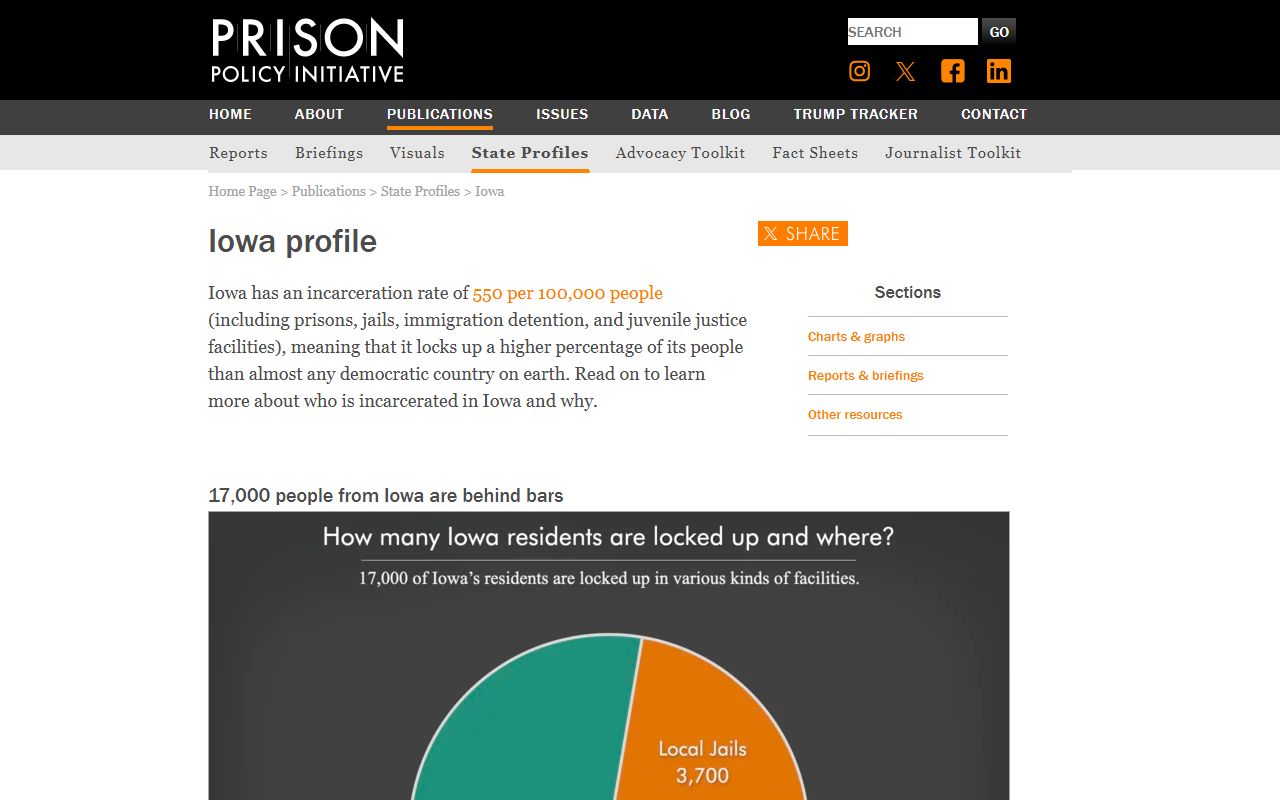
Comparing the same kind of rate across places is the only fair way to read a population number.
Population Trends Over Time
Trends tell a fuller story than any single day. A jail built in 2008 for a growing metro, with planned expansion capacity, signals that the county expected its population to rise over decades. Official Polk County annual average daily population, year-over-year totals, and booking counts were not located in the harvested pages, so a true multi-year trend should be pulled from county budget or annual reports and from Vera county data. The safe statement is that the jail was designed for long-term metro growth, with 1,500 current beds and room to add more.
How to Read the Daily Roster for Counts
If you want a current count, the live roster is the tool, and reading it well takes a little care. The current inmate listing is a table, so the number of rows is the count for that moment. Because the list refreshes as people are booked and released, two counts taken hours apart can differ. For a rough sense of the population, pick a consistent time of day and check on the same schedule, rather than comparing a morning count to an evening one.
Remember the roster's limits. It excludes people held on federal charges, so it undercounts everyone physically in the building. It is also a snapshot, not an average, and it carries the Sheriff's disclaimer that the data may be incomplete. For anything beyond a rough daily count, the agency reports remain the better source. Used carefully, though, the roster is a genuine window into who the county holds today.
Searching Polk County Inmate Records by Name
Population data describes the jail as a whole, but many visitors really want one person. That search is a different tool. To look up an individual in custody by name, use the jail roster on the inmate records page, and for someone recently let go, use the released inmates search. This page stays focused on the numbers behind the jail, not on individual lookups.