
The Role of the Clerk of District Court
Iowa does not use an elected county "district clerk" like some states. Court records are kept by the Clerk of District Court as part of the statewide Iowa Judicial Branch. The clerk maintains dockets and case files, accepts filings, collects court fees and fines, issues certified copies, and manages the public access terminals at the courthouse. Every clerk of court office in Iowa feeds the same online docket.
That structure means the clerk is your point of contact for anything tied to a court case. For case-specific questions, Iowa Courts Online directs users to contact the clerk in the county where the case was filed, which for a Polk County case is the Polk County Clerk of District Court. The court organization itself comes from Iowa Code chapter 602, which establishes the Judicial Branch, its clerks, and how court administration works across the state.
Polk County Clerk Contact and Hours
The clerk's office sits at the downtown Des Moines courthouse campus, near Court Avenue and Fifth Avenue. Office hours run on the standard weekday schedule. The contact card below is the office to reach for a Polk County court records request.
Polk County Clerk of District Court
222 Fifth Avenue
Des Moines, IA 50309
515-286-3737
Mon-Fri 8:00 a.m.-4:30 p.m.
The Iowa Court Directory lists the current clerk contacts, which is the best place to confirm a direct line before you call.
Iowa Courts Online and Public Terminals
Most people start with the free online docket before they ever contact the clerk. Iowa Courts Online is the electronic docket maintained for all clerk offices, and public docket access is free with no registration. You can read the index of filings, but many full documents are only available on a public access terminal at the courthouse where the case was filed.
The image below comes from the Iowa Courts Online landing page, the public docket the clerk's records feed into.
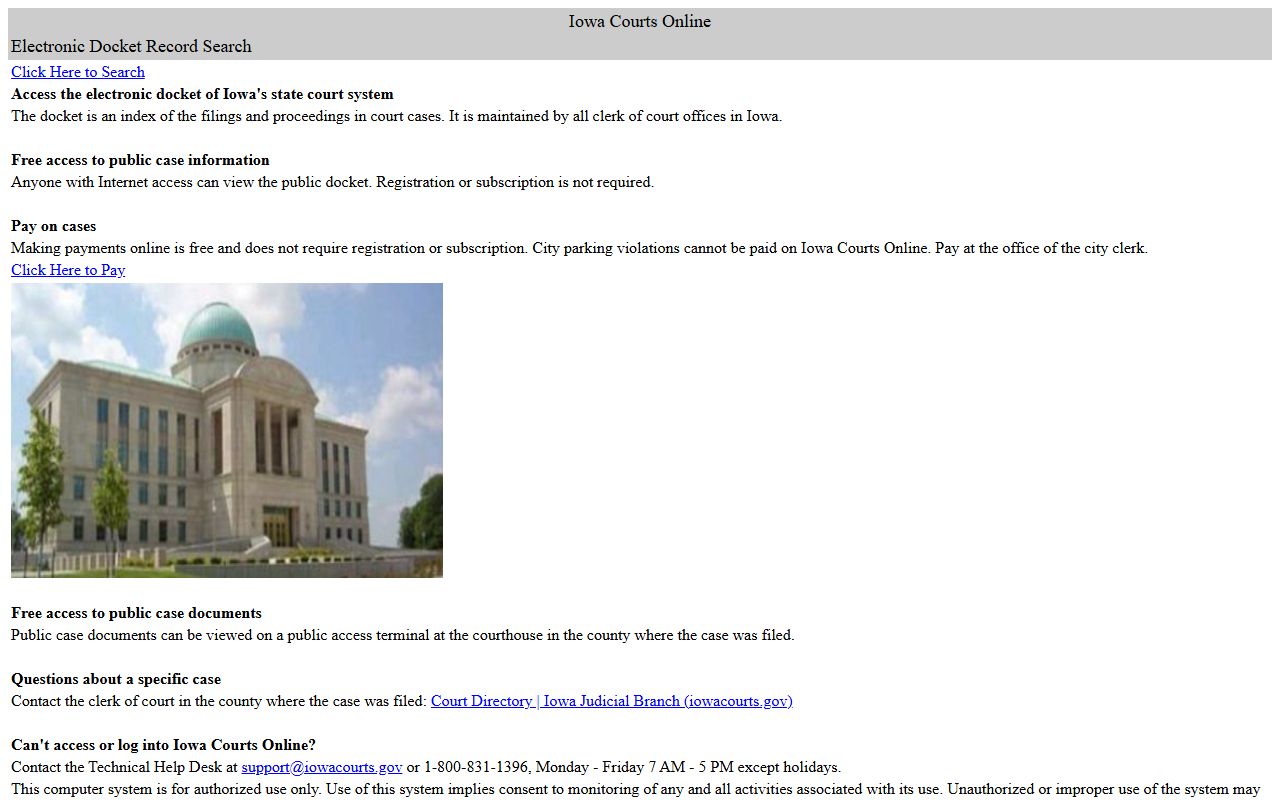
When the docket points to a document you cannot open online, the clerk and the courthouse terminal are the next step. The system also posts an authorized-use notice and warns that improper use may be punishable under state or federal law, so treat the records as the public, official files they are. For a county-specific question about a particular case, the clerk in the county where the case was filed is the right contact, and for Polk County that is the office downtown.
How to Request a Certified Copy
A certified copy carries the court seal and is the version courts, agencies, and employers accept. The clerk issues certified copies of court records, such as a divorce decree, a judgment, or a criminal disposition. The steps below outline a typical certified-copy request from the Polk County clerk.
- Find the case and case number on Iowa Courts Online.
- Contact or visit the Clerk of District Court with the case number.
- Specify which document you need and that you want it certified.
- Provide identification if the record or copy type requires it.
- Pay the copy and certification fee set by the Judicial Branch schedule.
Court Records Request Fields
A certified-copy request needs enough detail for the clerk to find the exact document and a way to collect the fee. The table below lists the elements a court records request usually involves.
| Field / Requirement | Type | Required | Notes |
|---|---|---|---|
| Case number | Text | Recommended | From Iowa Courts Online; speeds the search |
| Party name | Text | If no case number | Used to locate the case |
| Document requested | Text | Yes | Name the order, decree, or judgment |
| Certified or plain | Choice | Yes | Certified carries the court seal |
| Identification | Document | Where required | Some records limit who may receive a copy |
| Fee payment | Payment | Yes | Per Iowa Judicial Branch schedule |
If you are not sure which document you need, the clerk can point you to the right filing on the docket.
Clerk of District Court Fees
Copy and certification fees are set by the Iowa Judicial Branch fee schedule rather than the county. The exact current amounts were not published in the sources reviewed, so confirm them with the clerk before you request. The table lists the common charges.
| Item | Amount |
|---|---|
| Plain copy per page | Per Iowa Judicial Branch schedule; confirm current amount |
| Certified copy | Per Iowa Judicial Branch schedule; confirm current amount |
| Certification fee | Per Iowa Judicial Branch schedule; confirm current amount |
The clerk also collects court fines and case payments, many of which can be paid online through Iowa Courts Online.
Filing and eFiling Through the Clerk
The clerk accepts filings, and most case types in Iowa use the state eFile system. Self-represented filers can review the eFile instructions and the Judicial Branch forms before submitting. Fee waivers for people who cannot pay are handled through court forms. The clerk processes these filings into the case record, which then appears on the docket.
For people without a lawyer, the Judicial Branch self-help pages cover divorce, small claims, name changes, and more. The clerk cannot give legal advice, but staff can explain where a form goes and what a filing fee is. Electronic filing has become the standard route, so even people new to the court usually file online rather than on paper.
Court Fines and Payments
The clerk handles the money side of a case as well as the paperwork. Fines, court costs, restitution, and other case charges are collected by the clerk, and many can be paid online through Iowa Courts Online at no extra service charge. One exception stands out: city parking violations cannot be paid through Iowa Courts Online and must be paid at the office of the city clerk instead.
If you miss a payment or a court date, the case can pick up new consequences, such as a bench warrant. Checking the docket and contacting the clerk early is the simplest way to stay ahead of a problem. The clerk can confirm a balance, a due date, and the accepted payment methods.
What the Clerk Does Not Handle
It helps to know the limits of the office so you do not waste a trip. The clerk does not run formal criminal background checks; statewide criminal history is controlled separately under Iowa Code chapter 692. The clerk does not keep marriage records, deeds, or birth and death records; those belong to the County Recorder. The clerk also does not run the jail or post the inmate roster; that is the Sheriff's Office.
What the clerk does hold is the court case file: the filings, the orders, the judgments, and the certified copies that come from them. For anything outside that, the right office is the Recorder, the Sheriff, or a state agency.
Accessibility and Language Help
The Iowa Judicial Branch offers accommodations for people with disabilities and interpreters for those who need language help. The clerk's office and court administration handle these requests, and the safest practice is to ask early. When you request help, include the case number, the hearing date, and the specific accommodation you need, so staff have time to arrange it before the court date.
Requesting accommodations ahead of time avoids delays at the courthouse, where security screening can already slow entry. Early notice gives the court room to plan.
Clerk of District Court Versus County Recorder
Two county-related offices get confused, and the difference matters for a records request. The Clerk of District Court keeps court case files. The County Recorder keeps real estate records, vital records like marriage and birth, and similar official documents. They are separate offices with separate records.
| Record | Clerk of District Court | County Recorder |
|---|---|---|
| Court case files | Yes | No |
| Divorce decree | Yes | No |
| Marriage record | No | Yes |
| Deeds and real estate | No | Yes |
For the Recorder's records, see the County Recorder page. For court files, the clerk is the office.