
How to Find Polk County Marriage and Divorce Records
The split is simple once you know it. Marriage records and licenses come from the Polk County Recorder, the office that keeps vital records for the county. Divorce records come from the District Court, because a dissolution of marriage is a court case. Marriage is governed by Iowa Code chapter 595, and divorce is governed by Iowa Code chapter 598.
So a couple seeking a license, or anyone wanting a certified marriage copy, goes to the Recorder. Anyone seeking a divorce decree or a divorce case file goes to the court and Iowa Courts Online. Sending the request to the right office is the single most useful step.
Polk County Marriage Records and the Recorder
The Polk County Recorder preserves vital records, including marriage records, along with real estate records, passports, and military records. The Vital Records Department handles birth, death, and marriage records. The office is in the county administration building downtown, and same-day vital-record service ends before the office closes, so timing matters if you walk in.
Polk County Recorder, Vital Records
111 Court Avenue, Suite 250
Des Moines, IA 50309
Vital Records 515-286-3781
Mon-Fri 8:00 a.m.-4:30 p.m.; same-day vital service ends 3:30 p.m.
For more on the office and its other records, see the County Recorder page.
How to Apply for a Marriage License
A marriage license is issued before the ceremony, and the process follows Iowa's marriage law. The Recorder's vital records pages carry the current requirements and any waiting period. The steps below outline how a Polk County marriage license application moves from start to certified copy.
- Review the Polk County Recorder marriage and vital records requirements.
- Complete the application and any required witness portion.
- Bring valid government ID and the fee to the Recorder.
- Observe Iowa's waiting period and issuance rules.
- After the ceremony, the officiant returns the license for recording.
- Request a certified copy from the Recorder when you need one.
Marriage License Application Fields
The marriage application collects identity, age, and contact details for both applicants, plus a witness or affidavit where Iowa requires it. The table below lists the common fields. Confirm the exact current form and any accepted IDs with the Recorder before you go.
| Field Label | Type | Required | Notes / Format |
|---|---|---|---|
| Applicant 1 name | Text | Yes | Legal name |
| Applicant 2 name | Text | Yes | Legal name |
| Date of birth / age | Date | Yes | Used for legal capacity |
| Current address | Text | Yes | Mailing or residence |
| Identification | Document | Yes | Government ID; confirm accepted types |
| Witness / affidavit | Signature | Where required | Iowa typically requires a witness |
Because requirements can change, the Recorder's forms page is the authoritative source for the current application.
Marriage Record Fees
Fees apply to a marriage license and to certified copies, and they are set by the Recorder. The exact current amounts were not published in the sources reviewed, so confirm them with the Vital Records Department before you pay. The table lists the items you will be charged for.
| Item | Amount |
|---|---|
| Marriage license | Set by Polk County Recorder; confirm current amount |
| Certified marriage copy | Set by Polk County Recorder; confirm current amount |
| Additional certified copy | Set by Polk County Recorder; confirm current amount |
Calling ahead also lets you confirm payment methods, since vital-record offices often limit which forms of payment they accept.
Divorce Records in the District Court
Divorce is different from marriage in where the record lives. A dissolution of marriage is a District Court case governed by Iowa Code chapter 598, and Iowa is a no-fault dissolution state. The case may be searched on Iowa Courts Online, but sensitive financial details, minor information, and protected addresses can be restricted. Certified divorce decrees and orders come from the Clerk of District Court, not the Recorder.
That means a person confirming a past divorce can check the public docket for the case, then request a certified copy from the clerk. The court file, not the Recorder, holds the decree.
How to File for Divorce in Polk County
Filing for divorce in Iowa follows a set path, and the Judicial Branch self-help pages walk through it. The steps below summarize how a Polk County dissolution case moves from petition to final decree.
- Review the Iowa Judicial Branch divorce self-help forms.
- Confirm residency and that Polk County is the proper venue.
- Prepare the petition, confidential forms, and a financial affidavit.
- File through Iowa eFile or a clerk-approved process.
- Serve the respondent unless service is waived or accepted.
- Complete any waiting, parenting, and support steps.
- Attend the hearing or submit the final decree as the court allows.
The image below comes from the Iowa Judicial Branch divorce self-help page.
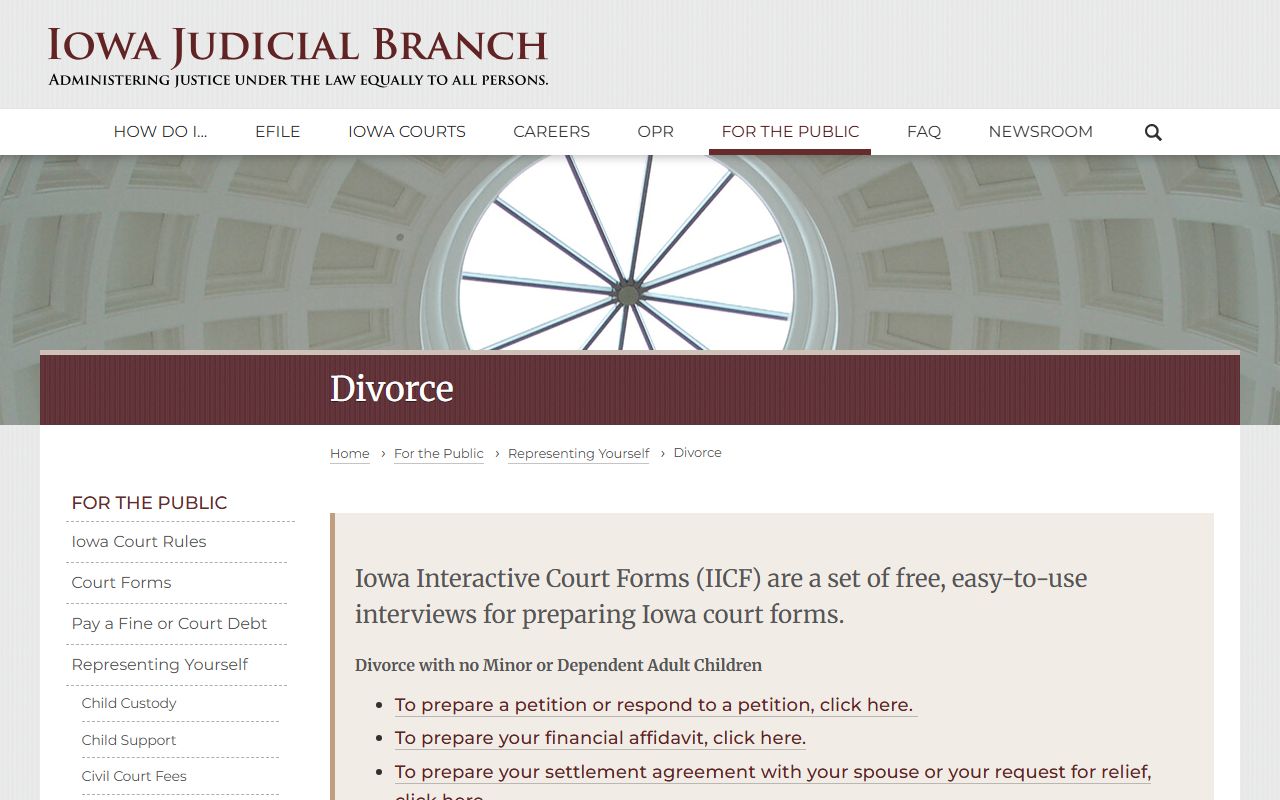
Self-represented filers should read these official forms before starting a case.
Confidential Divorce Information
Even though a divorce case is generally public, parts of it are protected. Financial affidavits, the identifiers of minor children, and protected addresses can be sealed or masked. Domestic-abuse and no-contact information may be limited for safety. These limits come from court rules and from the broader confidential-record categories in Iowa Code chapter 22.
So a public docket can confirm that a divorce happened and show many entries, while still keeping the most sensitive documents out of public view. If you need a protected document for a legal reason, the court decides access.
Note: A divorce docket can be public while financial and child-related details stay sealed, so the online record may not show every document in the case.
Older and Historical Marriage Records
Not every marriage record is recent, and the Recorder keeps older records too. The office runs a Microfilm and Imaging Department, which preserves and reproduces records that are not in the current online or counter system. For a marriage from decades back, that department is the place to ask, and it has its own contact line separate from the main vital records desk.
When you request an older record, give as much detail as you can: the full names of both spouses, the approximate date, and the place. Older records can be harder to locate, so the more you provide, the faster staff can find the right entry. For genealogy or legal use, ask whether a certified copy is available, since that is the version most agencies accept.
Who Can Request a Polk County Record
Access rules differ between the two record types. Marriage records held by the Recorder follow Iowa's vital-records and open-records rules, and certified copies may have eligibility limits, so confirm what the Recorder requires for a certified marriage copy. Divorce records held by the court are generally public on the docket, though sealed documents stay restricted. In both cases, the office that holds the record decides who may receive a certified copy and what proof of identity or relationship is needed.
If you are unsure whether you qualify to receive a certified copy, ask the office directly before you travel. A quick call can confirm the ID, the fee, and the form you need, which avoids a second trip.
Getting Certified Copies
Certified copies carry an official seal and are the version courts, agencies, and many employers accept. For a marriage record, the certified copy comes from the Polk County Recorder. For a divorce decree, the certified copy comes from the Clerk of District Court. A plain printout from an online docket is not a certified document, so for anything official, request the certified version from the right office. Plan a little extra time, since a certified copy may take longer than a counter printout, especially when the record is older or must be pulled from imaging.